

Installation FAQs
We've been building faucets for nearly half a century. And in that time, we've solved plenty of riddles for homeowners and pros alike. We've gathered some of our most-asked questions to life a little easier for you.
Installation
Although a wrench cannot be used on the caps or bonnet nuts, can a strap wrench be used?
Yes, you just need to be cautious not to scratch or bend the part.
Do you have any special instructions for installing pressure balance valves back-to-back?
Back-to-back installations require that the pressure balancing cartridge be "flipped" or rotated 180 degrees in order for both units to function properly. Flipping the cartridge will reverse the hot and cold-water supply lines so that the faucet works like a traditional hot/cold unit. The cartridge may also be flipped to correct a hot/cold reversal resulting from connecting the supply lines to the incorrect sides of the valve.
Here are the steps to follow in reversing the operation of your faucet:
- Before you begin, make sure that you shut off the water supply to the faucet.
- Remove the handle. A clear knob will have a Phillips head screw located just under the plastic cap; a lever handle usually has a small set screw located on the side.
- Slide off the finished metal sleeve that covers the valve.
- Unscrew the bonnet nut. The bonnet nut is a large brass ring and should unscrew by hand. If it is too tight, use a strap wrench, or wrap a towel around the bonnet and use a pair of channel locks. Make sure that the entire valve body does not start to rotate as you do this. Remove the bonnet nut.
- Do not pry the valve cartridge out of the body with a screwdriver. Place the handle on the cartridge stem and rotate it counterclockwise approximately 1/4 turn after the stop has been contacted. Remove the handle. Grasp the brass stem in the center of the white plastic assembly and pull it directly out, away from the wall. The valve cartridge should slide out of the brass valve body.
- Reinstall the cartridge after rotating the entire unit 180 degrees. Make sure that the raised plastic stop, marked "HOT", is on the right side of the valve.
- Reattach the bonnet nut, trim sleeve, and handle.
How can I make sure my shower is safe?
Here are some safety tips for you to observe with your shower:
- To avoid dangerously hot temperatures, make sure your water heater is set at 120° F or below.
- Install a pressure balance tub and shower valve.
- Set the valve's adjustable rotational limit stop to prevent the temperature handle from being turned to dangerously hot levels.
- Test the tub/shower water with your hand before bathing.
How do I set the adjustable rotational limit stop on my bath or shower?
Follow these steps:
- Let the water run until both hot and cold water is fully mixed.
- Rotate the handle fully counterclockwise, to the hottest position.
- Place a thermometer in a plastic tumbler and hold the tumbler in the water stream.
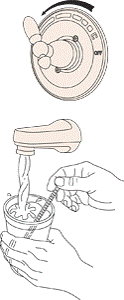
- If the water temperature is above what your local plumbing code allows (110° F or 120° F), remove the handle (to remove the handle, depending on the handle design, you may need a 1/8" or 3/32" hex key, or a Phillips screwdriver) or take off the temperature knob and rotate the rotational limit stop as follows:
- Turn the limit stop counterclockwise. For every tooth the rotational limit stop is rotated counterclockwise, the maximum water temperature will decrease approximately 6°F. NOTE: If your water temperature is too cool, rotate the limit stop clockwise.
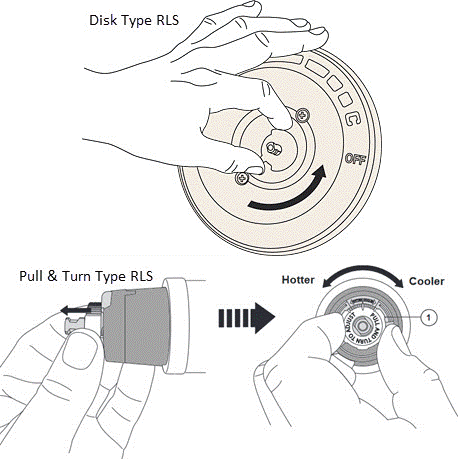
- Turn the limit stop counterclockwise. For every tooth the rotational limit stop is rotated counterclockwise, the maximum water temperature will decrease approximately 6°F. NOTE: If your water temperature is too cool, rotate the limit stop clockwise.
- Replace the handle. After verifying the water outlet temperature, secure the handle with the screw. Do not over tighten.
- MAKE SURE COLD WATER FLOWS FROM THE VALVE FIRST. ALSO MAKE SURE THAT YOUR WATER (AT THE HOTTEST FLOW) DOES NOT EXCEED THE TEMPERATURE ALLOWED (see steps 1-4 above).
Note: Consumer safety is our number one concern. If you do not have experience with plumbing repairs, we recommend that you contact a licensed plumber for tub/shower repairs.
My single handle kitchen faucet keeps loosening up on our sink. Why?
Most likely your sink has a very smooth underside and with use, the mounting bracket is loosening up over time. We recommend placing some emery cloth between the sink and the mounting bracket of the faucet to help give it some traction when tightened down.
The water in the shower is either hot or cold; I cannot get any temperature in-between. What's wrong?
The spool and sleeve, the part of the pressure balance valve that blends the hot and cold-water, may not be working properly. This can be caused by mineral deposits that build up over time, resulting from hard water. To solve, follow the steps below.
Tools you may need before starting: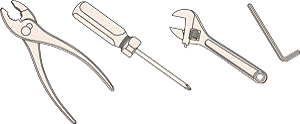
- Shut off the water supply.
- Remove the handle.
- Twist and pull sleeve to remove it.
- Unscrew brass bonnet nut.
- Remove the cartridge.
- Tap the cartridge side in your palm. The spool inside should rattle when you shake the cartridge.
- Soak cartridge in a 50/50 vinegar and water solution for 8-12 hours to remove mineral deposits that may be clogging the cartridge.
NOTE: Unless both the hot and cold water supplies are turned on, the pressure balance valve will allow only a dribble of water to flow through the valve.
What are the proper flushing procedures for a new faucet?
During the first few days you use your faucet, a small amount of debris may be flushed out of your pipe system. This happens even though the plumber flushes the pipes before completing work on your home. In addition, particles of solder, copper chips, plumber's tape and other installation materials can get caught in aerators and showerheads. Occasionally, a chip might damage the valve seat that provides the watertight seal. The tips below will help you avoid problems. It's a good idea to follow these procedures each time the water has been turned off for repairs in your home.
TO FLUSH A KITCHEN OR LAVATORY FAUCET:
- Remove aerator and black sealing gasket above it.
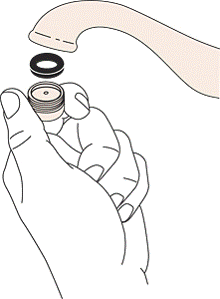
- Turn faucet handle(s) to full on hot and cold mixed position(s) and flush lines for two minutes before turning off water with handle(s).
- Replace aerator.
TO FLUSH A TUB / SHOWER FAUCET:
- Remove showerhead if applicable
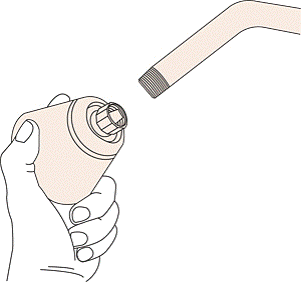
- Turn handle(s) to full on hot and cold mixed position(s).
- Flush spout two minutes without moving handle(s).
- If you have a showerhead, divert water to it and flush for two minutes. BE SAFE! Make sure cold water flows FIRST and that the rotational handle limit stop is properly set. See information on setting the adjustable limit stop.
- Replace showerhead.
If problems persist, flush the faucet and lines using these instructions:
- Turn off water supply to both hot and cold.
- Remove all internal components.
- Turn water supplies back on and let run for 30-60 seconds. (For kitchen and lavatory faucets turn a bucket or similar large container upside down over faucet to deflect the water into the sink.)
- Turn water supplies off again.
- Reassemble faucet.
- Turn water supplies back on.
Does my shower valve protect me from sudden hot or cold-water changes?
Yes. The Peerless shower valves feature a stainless-steel pressure balancing spool, which is a safety part inside that keeps the water temperature steady, reducing the risk of a scalding or chilly blast from the shower. This safety feature protects the user by equalizing the water pressure inside of the shower valve itself if there is a decrease in pressure from the hot or cold-water supply. If a pressure change were to occur the faucet will automatically readjust the water pressure from the opposite side so that it is equal with the supply that dropped in pressure. Meaning that if someone is in the shower and the toilet is flushed, the valve will reduce the hot water pressure coming into the faucet to match the cold. This ensures a constant temperature within + or - 3 degrees Fahrenheit.
If you always have large differences between hot and cold-water pressures, the faucet will only allow water through at the lower pressure. If you have a hot water supply of 25 PSI (pounds per square inch) and the cold-water supply of 60 PSI, the faucet will always operate at 25 PSI.
What is the adjustable rotational limit stop?
The adjustable rotational limit stop found on Peerless® valves allows you to set a maximum hot water temperature for water flowing out of the tub/shower. When set correctly, this safety feature will ensure that the handle in your tub/shower faucet never rotates beyond the set level—resulting in a safe bathing temperature.
It may need to be readjusted if the inlet water temperatures change. For example, during the winter, the cold-water temperature is colder than it is during the summer, which could result in varying outlet temperatures. Typical temperatures for a comfortable bath or shower range from 90° F to 110° F.
What tools should I have before I begin installing my faucet?
Some common tools include:
- Basin wrench
- Adjustable wrench
- Silicone sealant - Plumber's Putty is not generally recommended
- Plumber's Tape
- Channel locks
- Screwdriver (Phillips and slotted)
- Flashlight
Please refer to the Maintenance & Installation Sheet supplied with the faucet to make sure you have all the necessary tools. If you need a Maintenance & Installation Sheet for your faucet, visit the Online Catalog and search for your faucet. When your faucet appears, select the Maintenance & Installation option to view the installation information.
Who can I call if I need help while I'm installing my faucet?
You can call us here at 1-800-438-6673 Monday - Friday: 8 a.m. - 7 p.m. EST and Saturday: 9 a.m. - 6 p.m. EST or Click here to send a message directly to Customer Service.
Why does the Peerless® name face the back of the faucet?
The faucet is in the wrong position.
To correct an uninstalled faucet:
- Rotate the spout 180 degrees so the Peerless® name appears below the spout.
To correct an installed faucet:
- Shut the water off at the water supplies.
- Disconnect the faucet and remove it from the sink.
- Rotate the spout 180 degrees so the Peerless name appears below the spout, and it faces toward the sink.
- Reinstall the faucet.
Why does water come out of my shower head and the spout at the same time?
Most likely you are experiencing "shower-rise," where the water can't get out of the spout as fast as it flows through the valve. This causes the water to back up and come out the shower head. There can be one of several reasons for this:
- The valve could be upside down.
- The length from the valve to the tub spout is outside of the 8" to 18" rule.
- There is more than one 90-degree angle.
- Something other than copper or galvanized pipe going to the spout was used.
- The most common reason is that there is something restricting the water flow to the spout (for example, solder or something lodged in the pipe). Something is impeding the flow of water to the spout and causing it to back up and go out of the shower head. If this is the cause of shower-rise, it is possible to remove the blockage by removing the tub spout, and then feeding a plumber's snake or a speedometer cable up through the tub drop. The act of feeding it causes it to twirl and loosen the blockage. Be sure to flush the valve before reinstalling the tub spout. Be sure to check the tub spout itself for blockage.
If none of these help, you may need to call a plumber. After the shower has been installed and the wall has been closed, there is little that can be done to remedy this situation yourself.