

Water Temperature FAQs
We've been building faucets for nearly half a century. And in that time, we've solved plenty of riddles for homeowners and pros alike. We've gathered some of our most-asked questions to life a little easier for you.
Water Temperature
How can I make sure my shower is safe?
- To avoid dangerously hot temperatures, make sure your water heater is set at 120º F or below.
- Install a pressure balance tub and shower valve.Set the valve’s adjustable rotational limit stop to prevent the temperature
- handle from being turned to dangerously hot levels.
- Test the tub/shower water with your hand before bathing.
How do I set the adjustable rotational limit stop?
Follow these steps:
- Let the water run until both hot and cold water is fully mixed.
- Rotate the handle fully counterclockwise, to the hottest position.
- Place a thermometer in a plastic tumbler and hold the tumbler in the water stream.
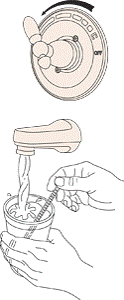
- If the water temperature is above what your local plumbing code allows (110° F or 120° F), remove the handle (to remove the handle, depending on the handle design, you may need a 1/8" or 3/32" hex key, or a Phillips screwdriver) or take off the temperature knob and rotate the rotational limit stop as follows:
- Turn the limit stop counterclockwise. For every tooth the rotational limit stop is rotated counterclockwise, the maximum water temperature will decrease approximately 6° F. NOTE: If your water temperature is too cool, rotate the limit stop clockwise.
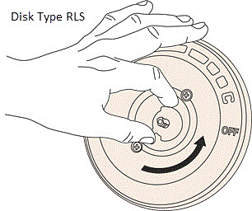
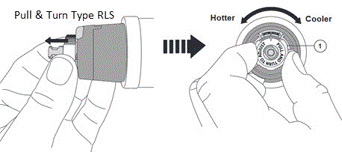
- Turn the limit stop counterclockwise. For every tooth the rotational limit stop is rotated counterclockwise, the maximum water temperature will decrease approximately 6° F. NOTE: If your water temperature is too cool, rotate the limit stop clockwise.
- Replace the handle. After verifying the water outlet temperature, secure the handle with the screw. Do not over tighten.
- MAKE SURE COLD WATER FLOWS FROM THE VALVE FIRST. ALSO MAKE SURE THAT YOUR WATER (AT THE HOTTEST FLOW) DOES NOT EXCEED THE TEMPERATURE ALLOWED (see steps 1-4 above).
Note: Consumer safety is our number one concern. If you do not have experience with plumbing repairs, we recommend that you contact a licensed plumber for tub/shower repairs.
If the hot water comes on first in a pressure balance valve when you rotate the handle counterclockwise, what’s wrong?
The water lines may have been connected in reverse. Cold water should always come on first when you’re operating a pressure balance valve and then rotating the handle counterclockwise should increase temperature. If that’s not the way things are happening, you may be able to correct the problem by "flipping" the pressure balancing cartridge.
Here are the steps to follow in reversing the operation of your faucet:
- Before you begin, make sure that you shut off the water supply to the faucet.
- Remove the handle. A clear knob will have a Phillips head screw located just under the plastic cap; a lever handle usually has a small set screw located on the side.
- Slide off the finished metal sleeve that covers the valve.
- Unscrew the bonnet nut. The bonnet nut is a large brass ring and should unscrew by hand. If it is too tight, use a strap wrench, or wrap a towel around the bonnet and use a pair of channel locks. Make sure that the entire valve body does not start to rotate as you do this. Remove the bonnet nut.
- Do not pry the valve cartridge out of the body with a screwdriver. Place the handle on the cartridge stem and rotate it counterclockwise approximately 1/4 turn after the stop has been contacted. Remove the handle. Grasp the brass stem in the center of the white plastic assembly and pull it directly out, away from the wall. The valve cartridge should slide out of the brass valve body.
- Reinstall the cartridge after rotating the entire unit 180 degrees. Make sure that the raised plastic stop, marked "HOT", is on the right side of the valve.
- Reattach the bonnet nut, trim sleeve, and handle.
The water in the shower is either hot or cold; I cannot get any temperature in-between. What’s wrong?
The spool and sleeve, the part of the pressure balance valve that blends the hot and cold water, may not be working properly. This can be caused by mineral deposits that build up over time, resulting from hard water. To solve, follow the steps below.
Tools you may need before starting: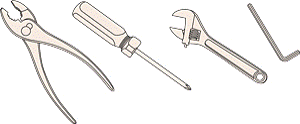
- Shut off the water supply.
- Remove the handle.
- Twist and pull sleeve to remove it.
- Unscrew brass bonnet nut.
- Remove the cartridge.
- Tap the cartridge side in your palm. The spool inside should rattle when you shake the cartridge.
- Soak cartridge in a 50/50 vinegar and water solution for 8-12 hours to remove mineral deposits that may be clogging the cartridge.
NOTE: Unless both the hot and cold water supplies are turned on, the pressure balance valve will allow only a dribble of water to flow through the valve.
Does my shower valve protect me from sudden hot or cold-water changes?
Yes. The Peerless shower valves feature a stainless-steel pressure balancing spool, which is a safety part inside that keeps the water temperature steady, reducing the risk of a scalding or chilly blast from the shower. This safety feature protects the user by equalizing the water pressure inside of the shower valve itself if there is a decrease in pressure from the hot or cold-water supply. If a pressure change were to occur the faucet will automatically readjust the water pressure from the opposite side so that it is equal with the supply that dropped in pressure. Meaning that if someone is in the shower and the toilet is flushed, the valve will reduce the hot water pressure coming into the faucet to match the cold. This ensures a constant temperature within + or - 3 degrees Fahrenheit.
If you always have large differences between hot and cold-water pressures, the faucet will only allow water through at the lower pressure. If you have a hot water supply of 25 PSI (pounds per square inch) and the cold-water supply of 60 PSI, the faucet will always operate at 25 PSI.
What is the adjustable rotational limit stop? When or why would it need to be readjusted?
The adjustable rotational limit stop found on Peerless® valves allows you to set a maximum hot water temperature for water flowing out of the tub/shower. When set correctly, this safety feature will ensure that the handle in your tub/shower faucet never rotates beyond the set level—resulting in a safe bathing temperature.
It may need to be readjusted if the inlet water temperatures change. For example, during the winter, the cold-water temperature is colder than it is during the summer, which could result in varying outlet temperatures. Typical temperatures for a comfortable bath or shower range from 90° F to 110° F.
See information on adjusting the rotational limit stop.